PyTC
Python TransCorrelation package
User Guide
API Reference
Development
Features
JAX-based automatic differentiation for Jastrow gradients and Laplacians via folx — single-pass forward Laplacian, JIT-compiled to fused GPU kernels, avoiding the cost of finite differences entirely.
Multi-GPU acceleration via JAX sharding for both VMC sampling and integral evaluation — near-linear strong scaling across devices with no user-side code changes.
Transcorrelated integrals: K1, K2, K3 two-body and xTC approximated three-body integrals — fully GPU-resident contractions, never materialising the 3-body tensor explicitly.
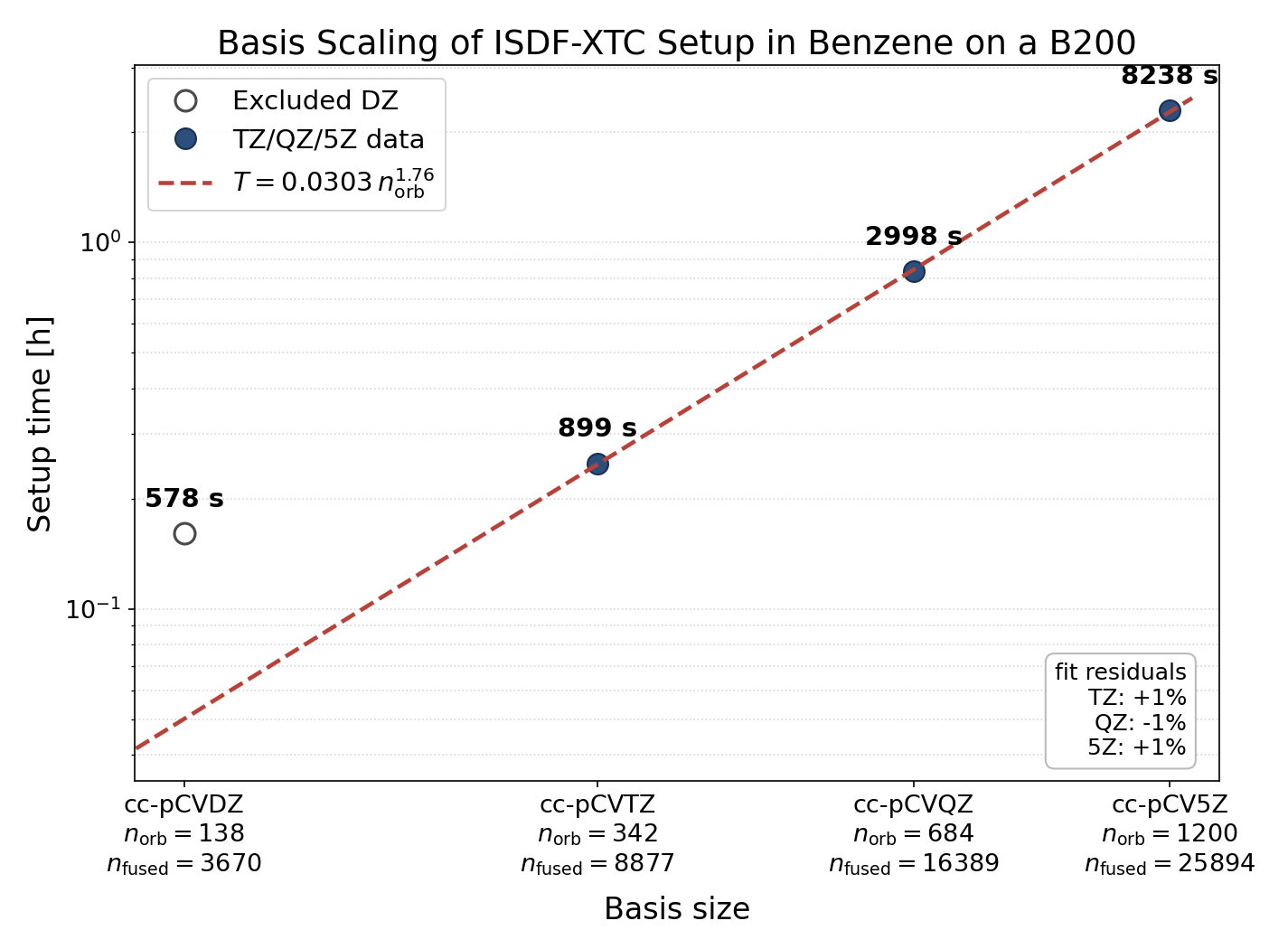
Interpolative Separable Density Fitting (ISDF) for the xTC kernel — empirical \(T \propto n_{\mathrm{orb}}^{1.76}\) scaling (see plot above) pushes routine calculations past 1200 orbitals on a single B200, which is beyond what standard quantum chemistry solvers can handle.
Validated ISDF efficiency controls: deterministic blocked pivot selection, exact auxiliary recovery of K1/K3, and an opt-in rank-\(M\) orbital Tucker representation whose dedicated solver contracts T2 directly with the factors.
Modular Jastrow factors: Boys-Handy, Nuclear Cusp, Neural Network (EE/EN/EEN), REXP, Polynomial, and Composite — share the same JIT-compiled evaluation path, so adding a new factor adds zero per-step overhead.
VMC-based Jastrow optimization with second-order Newton and first-order ML optimizers (Adam) — second-order steps reach the same accuracy in an order of magnitude fewer iterations than SGD.
PySCF interoperability with JAX-native CCSD: Builds on PySCF mean-field objects and molecular data, then runs xTC-CCSD with PyTC’s in-house JAX solver